7 Best Taylor Wharton Tanks for Global Buyers?

Global buyers comparing taylor wharton tanks need more than a familiar brand name. They need equipment suited to the gas, operating conditions, and delivery route. GIIGNL’s Annual Report 2024 recorded 401.4 million tonnes of global LNG trade in 2023. That figure shows the scale of international gas movement, but it does not determine which tank a facility needs. Different gases and applications require different specifications.

A useful shortlist compares storage capacity, design pressure, insulation, materials, and available service support. Buyers should also check documentation, site requirements, and the availability of compatible spare parts. A tank designed for one cryogenic service may not suit another. Confirm each model’s published specifications with the manufacturer or an authorized supplier before making a decision.

This guide examines seven Taylor-Wharton options through a buyer-focused lens. It highlights practical differences, not a universal winner. A shortlist can still mislead. The best choice depends on the project’s actual duty, installation constraints, and local support—not just the product name. Use the comparison as a starting point, then verify current technical data and suitability directly.
7 Best Taylor Wharton Tanks for Global Buyers?

Understanding Taylor-Wharton Tanks and Their Global Applications

Cryogenic tanks store liquefied gases at very low temperatures, using insulation and pressure-control components to limit heat transfer. They support laboratories, healthcare facilities, food processing, and industrial production. The right design depends on the gas, required capacity, delivery method, and daily usage. A compact vessel may suit a research site, while a production facility may need larger storage and reliable transfer equipment.

Global conditions matter. Outdoor tanks may face strong sun, humidity, coastal air, or wide temperature swings. Buyers should check insulation performance, materials, fittings, monitoring systems, and maintenance access. Ask for clear technical documents and confirm that the equipment meets applicable local requirements. A specification sheet can look reassuring, but it cannot show whether a tank fits a particular site. That needs careful review.

Tips: Match capacity to real demand, not a rough guess. Check delivery access, foundation needs, spare-part availability, and service support before ordering. Confirm operating instructions are available to local staff. Small details matter. I would still leave room for a site assessment; planning from a distance can miss practical obstacles.


Key Criteria for Comparing Taylor-Wharton Tank Options

Comparing cryogenic tank options starts with the job they must perform. Check usable capacity, operating pressure, and the liquid’s expected hold time. A vessel’s nameplate capacity may not equal the volume available for routine use. Ask for test data under conditions close to your site, including ambient temperature and typical withdrawal rates. Insulation quality matters, but so do valve layout and connection sizes. A poorly placed outlet can make daily handling awkward.

Tips: Measure doorways, loading areas, and the final installation space before choosing a model. Confirm that hoses, fittings, and monitoring equipment match your setup. Small details matter.

Also compare transport needs, service access, and documentation. A compact tank may suit a laboratory, while a larger installation may need clear access for inspection and maintenance. Review pressure-relief features and operating instructions with qualified personnel. Ask how performance figures were measured; comparisons are weak when test conditions differ. One practical point is easy to overlook: staff may need time to learn unfamiliar controls. I would not choose from capacity alone. Even a well-specified tank can disappoint if its layout clashes with the way people actually work.

7 Cryogenic Tank Options for Global Buyers Key criteria for comparing common storage and transport configurations
Tank option Typical capacity Typical application Main advantages Key comparison criteria
Small vacuum-insulated dewar About 5–200 L Laboratories, medical facilities, and small-volume liquid nitrogen use Compact, portable, and suitable for frequent small withdrawals Neck opening, hold time, evaporation rate, handling method, and compatibility with the stored cryogen
Mobile liquid cylinder About 100–1,000 L On-site supply of cryogenic liquids where a fixed bulk tank is impractical Can be moved on site and may provide liquid or gas through suitable equipment Working pressure, outlet arrangement, residual liquid, delivery access, and local transport rules
Microbulk tank system About 450–5,000 L Small to medium users needing a replenished, on-site supply Combines insulated storage with delivery and pressure-control equipment in a relatively compact installation Daily consumption, delivery frequency, vaporizer requirements, footprint, and telemetry availability
Vertical stationary bulk tank About 1,000–80,000 L Industrial, healthcare, and institutional sites with regular cryogenic demand Uses ground space efficiently and supports larger on-site inventories Foundation and height limits, usable capacity, pressure range, boil-off management, and filling access
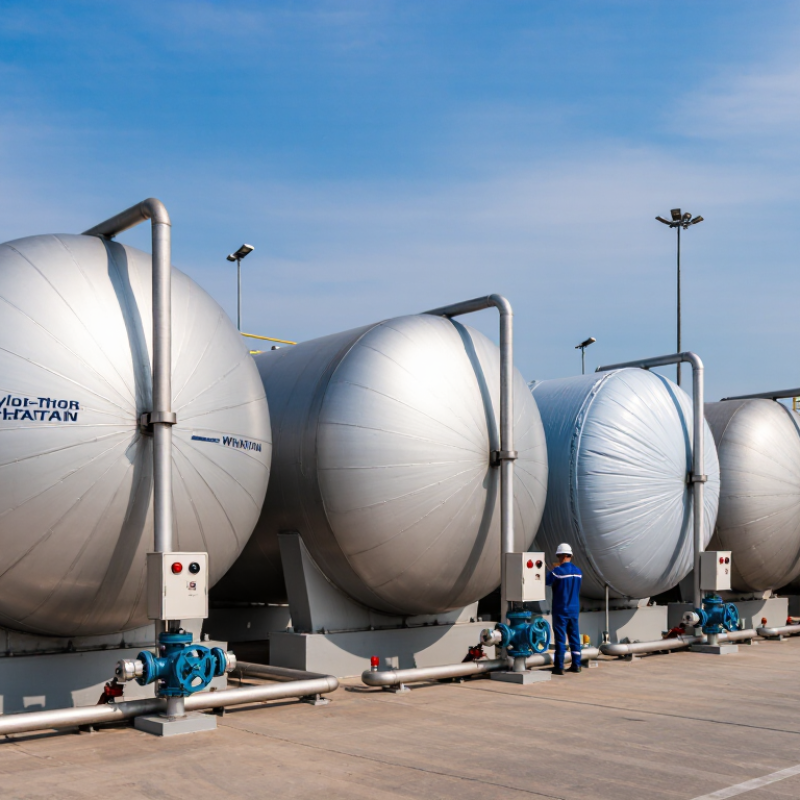
Horizontal stationary bulk tank About 1,000–80,000 L Sites with height restrictions or layouts suited to a low-profile vessel Lower overall profile than many vertical installations and can be arranged for accessible servicing Available footprint, support and anchoring needs, vehicle access, pressure range, and site clearances
ISO cryogenic tank container Commonly about 20,000–45,000 L Intermodal movement of cryogenic liquids by road, rail, or sea, subject to approvals Containerized format supports multimodal logistics and temporary or remote supply Applicable transport approvals, payload limits, product compatibility, route restrictions, and loading connections
Large field-erected storage tank Typically above 80,000 L; project-specific High-throughput industrial plants, terminals, and large distribution facilities Can be engineered for very large inventories and high transfer rates Engineering scope, site preparation, safety distances, inspection requirements, project schedule, and lifecycle cost
Capacity figures are indicative ranges for common equipment categories, not guaranteed specifications. Actual capacity, operating pressure, materials, heat leak, and permitted use vary by design, stored product, jurisdiction, and applicable standards. Confirm the required liquid or gas service, site conditions, delivery method, and regulatory approvals with qualified suppliers and local authorities before selection.

Seven Taylor-Wharton Tanks to Consider for International Use

For international projects, a useful shortlist spans seven formats: vertical stationary vessels, horizontal stationary vessels, transportable tanks, ISO cryogenic containers, microbulk systems, liquid-nitrogen dewars, and LNG storage tanks. Each serves different capacity, handling, and route needs. Small details matter. A compact dewar suits frequent, smaller withdrawals; a large stationary vessel fits steady site demand. Transportable and ISO units can simplify multimodal shipping, but dimensions, tare weight, and connection standards need checking against the destination infrastructure.

The International Energy Agency’s Gas 2024 report records 401 million tonnes of global LNG trade in 2023, a 2.4% annual increase. That figure signals active cross-border LNG movement, not that every tank design suits every route. Buyers should compare usable capacity, pressure and temperature ratings, insulation performance, and documented testing. Ask for technical drawings and operating limits, not just a catalogue capacity. The difference can be easy to miss.

For oxygen, nitrogen, argon, or LNG service, confirm product compatibility and specify the applicable design code with the supplier. Review valve placement, lifting points, spare-parts access, and local service coverage before ordering. A tank may meet its stated specification yet still be awkward to unload at a particular port. That practical check deserves more attention.

Matching Tank Capacity and Design to Storage Requirements

A tank should fit the actual storage pattern, not just look impressive on a specification sheet. Estimate daily use, delivery intervals, and peak demand before comparing capacities. A facility with steady consumption may need less reserve than one receiving supplies only once a week. Check usable volume, too; fittings and operating limits can make it lower than the stated capacity.

Small details matter. Measure the installation area, including access for inspection and maintenance. A tall tank can save floor space, but it may need suitable foundations and clearance above. Consider inlet and outlet positions, drainage, ventilation, and whether insulation is necessary for the stored material and local climate. Material compatibility should be confirmed using technical documentation, not appearance alone.

An oversized tank is not automatically a better choice. It can occupy valuable space and leave stored contents sitting longer than planned. A smaller unit may require frequent refilling, though, which can disrupt operations. There is no perfect size on paper. Compare several capacities against realistic demand, available site space, and delivery schedules, then have a qualified engineer review structural and installation requirements. Even careful estimates can miss seasonal changes, so leave room to reassess.

Evaluating Safety, Service, and Worldwide Support

Selecting a cryogenic tank for international use takes more than comparing capacity and price. Match the vessel’s working pressure, usable volume, stored fluid, and refill schedule to the actual site. Request inspection records, material specifications, pressure-relief device details, and clear operating instructions. Safety depends on correct installation, trained operators, ventilation, and routine checks—not the vessel alone. Small leaks matter.

Service access can be decisive when equipment operates far from its supplier. Before purchase, confirm who can provide technical guidance, replacement parts, and maintenance support in the destination country. Ask about response times, language options, and how service requests are handled across time zones. Check packaging and shipping arrangements, too; a delayed component can interrupt operations. A checklist helps, but it may still miss local handling constraints. Revisit it with the people who will run the equipment.

Tips: Keep inspection and maintenance records together, and train staff to recognize abnormal pressure or frost patterns. Confirm support contacts before delivery. Do not assume worldwide coverage means on-site service; ask what is available at your location.